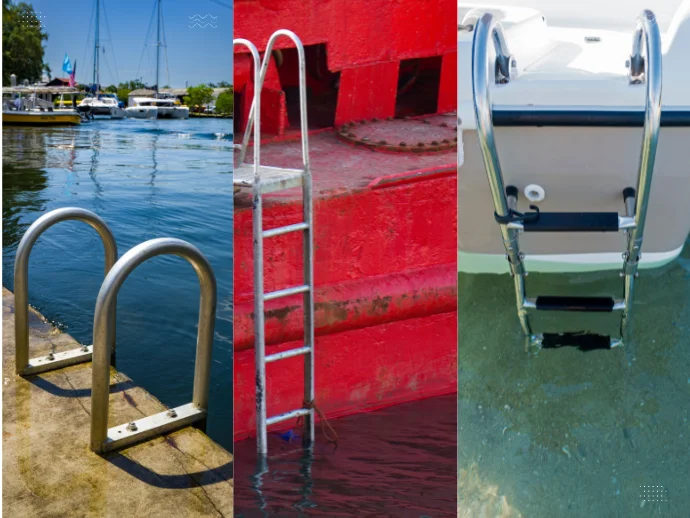
Ladders are very crucial to recreational boating. Whether you are returning from a refreshing swim or climbing back into the boat after a dip offshore, a reliable and practical ladder makes a mile of difference.
For novices, a boat ladder is often an afterthought, but experts and boating veterans are well aware that a good boat ladder is more than just a piece of hardware; it is an indispensable step towards safety, comfort, and convenience.
If you select the wrong one, you are stuck with awkward climbs, wobbly steps, or worse – a dangerous fall. And, your time on the water becomes easier and more enjoyable when you choose the right one.
So, now that the context is set, let’s check out the ways to choose the perfect boat ladder.
6 Boat Ladders That You Must Know Of
You can find an array of boat ladders, each suited to different boats, users, and mounting styles.
1. Platform Ladders
These are the most common types of boat ladders. They are either mounted on top of or underneath the swim platform, and can be accompanied by a nearby grab handle for easier boating. You can deploy a platform ladder by flipping it over for the steps to telescope out into the water. And, when not in use, you can condense the steps for the ladder to flip back over.
Pros:
- Highly stable
- Easy to climb
- Suitable for children and elderly passengers
Cons:
- They take up a lot of space
- Require a platform
Best For: Boats with integrated swim platforms
2. Transom Ladders:
Transom ladders are mounted on the back (stern) of a boat at a vertical or angled position. They are usually equipped with standoffs that help stabilize the passenger when they are trying to get on or off the boat using the ladder. You can deploy a transform ladder by simply popping it out of the clip brackets and folding it down into the water against the transom of the boat. These are most commonly seen on ski boats and fishing vessels that lack a swim platform.
Pros:
- Available in compact, foldable designs
- Easy to deploy from water
Cons:
- Limited space on some transoms
- May interfere with outboards if sized incorrectly
Best For: Compact boats, swim boats, day cruisers, sports-usage boats, and deep-water entry
3. Gunwale Ladders or Side-Mount Ladders
These are attached to a boat’s side rail and are fully removable. Gunwale ladders are a great choice if your boat does not have mounting points or if you do not want to drill into the fibreglass.
Pros:
- Easily removable
- Great for boats with limited stern space
Cons
- Less stable
- Can mark gunwales if not padded
Best For: Deep water boarding
4. Pontoon Ladders
These are specific to pontoon-style boats that sit lower to the water but still need a ladder that is wide, sturdy, and safe for barefoot kids or pets. Pontoon ladders are heavy-duty, reliable, sturdy, and are usually installed on the back of a boat. They come in fold-up and fixed variations, and some can even be mounted under the deck for a plush finish. When not in use, the regular pontoon ladders take up a lot of space, but that is not a problem, as pontoons are some of the most spacious boats that anyone can own.
Pros:
- Extremely stable
- Wider and comfortable steps
- Low maintenance
Cons
- Higher cost compared to basic boat ladders
- Take up a lot of space
Best For: Sandy feet, wiggly dogs, and family use
5. Dive Ladders
Dive ladders come in different styles and types. Tough, wide, and highly stable, they are an excellent option for ocean diving, and if you are wearing fins or hauling a tank. They are usually installed at the entrance of a dive door, found on the side of a boat. But not all boats have these. Dive ladders can be fixed or foldable, or telescopic, based on the brand you go for.
Pros:
- Provides stability in waves
- Enhances safety
- Gives easy re-entry into the boat for divers
Cons:
- Space and storage issues
- Some dive ladders can be difficult to use in rough seas
Best For: Divers, snorkelers, and heavy-duty use
6. Rope Ladders
These are lightweight, compact, and easy-to-store ladders, and are usually kept on board as an emergency precaution. Rope ladders are most commonly used for inflatable boats that have space constraints.
Pros:
- Very portable
- Good option for emergencies
- Budget-friendly
Cons:
- Harder to climb
- Cannot be used as a primary option for larger boats
- Not ideal for kids or older adults
Best For: Inflatable boats or as an emergency option
Select The Best Boat Ladder – Five Steps To Follow
1. The Boat Size & Style
Different boats need different types of ladders based on transom height, hull shape, mounting space, and more. So, you should check all the aspects and choose a boat ladder that fits the requirements. For example, if you have a pontoon boat, a pontoon ladder or a platform ladder can be a great choice. Likewise, side-mount or gunwale ladders are ideal for fishing boats, and so forth.
2. Find The Purpose
What will be the primary purpose of your boat ladder? Is it for swimming or watersports, or for divers with heavy gear? Find this main objective and then make a choice. For example, divers need a ladder with wide, sturdy steps and a deeper water reach.
3. Ladder Length & The Number of Steps
The right number of steps and the adequate length are crucial in choosing the perfect boat ladder. A ladder should extend at least 12 to 18 inches below the waterline, and even more for deep-freeboard boats. Three-step ladders work best for boats close to the waterline, whereas 4-5 step ladders are ideal for higher boats or divers. Remember that the deeper the first step goes, the easier it is to climb up.
4. Weight
A good boat ladder must support even the heaviest person on board, plus extra requirements. The standard capabilities usually range from 250 to 400 pounds. If you have more adult passengers or heavy diving gear, it is best to consider a ladder with a higher weight capability.
5. Material
Boat ladders must be made of the right material, as they regularly come in contact with water, sun, and constant use. Stainless steel ladders are supremely durable, corrosion-resistant, and give off a sleek look. However, they are more expensive.
Similarly, aluminum is also a viable option, as it is lightweight, easy to handle, and more affordable. However, if your boat operates more in saltwater, then aluminum may not be the ideal choice, as it corrodes faster in saline water unless properly coated.
Lastly, plastic or composite steps are also something you can consider if you are on a budget.
Key Takeaways
Long story short, a boat ladder is not just an accessory; it is a vital tool that ensures safe and secure re-boarding for you and your fellow passengers, including kids and older individuals. It also offers great convenience when docking, loading, or entering the water and prevents accidents like falls or slips.